Forio and Wharton Launch a New Era of Business Simulations with Google’s Gemini Veo
Wharton updates its flagship MBA experience with the launch of WTLS v2, bringing AI-powered creative expression to its students.
January 28, 2026
Drew Marx
Key Takeaways
Wharton chose Forio to pioneer AI integration in its flagship first-week course that frames students' entire two-year MBA program.
WTLS v2 demonstrates AI enabling creative expression in business education, not just analytical tasks.
Wharton MBA students learned to work with generative AI tools they'll encounter in their careers.
Non-technical students created professional-grade marketing materials using only text prompts.
Every incoming Wharton MBA student begins their program the same way: with Management 6100, a required, first-week course that sets the tone for how students will approach teamwork, leadership, and decision-making throughout their two-year Master’s program.
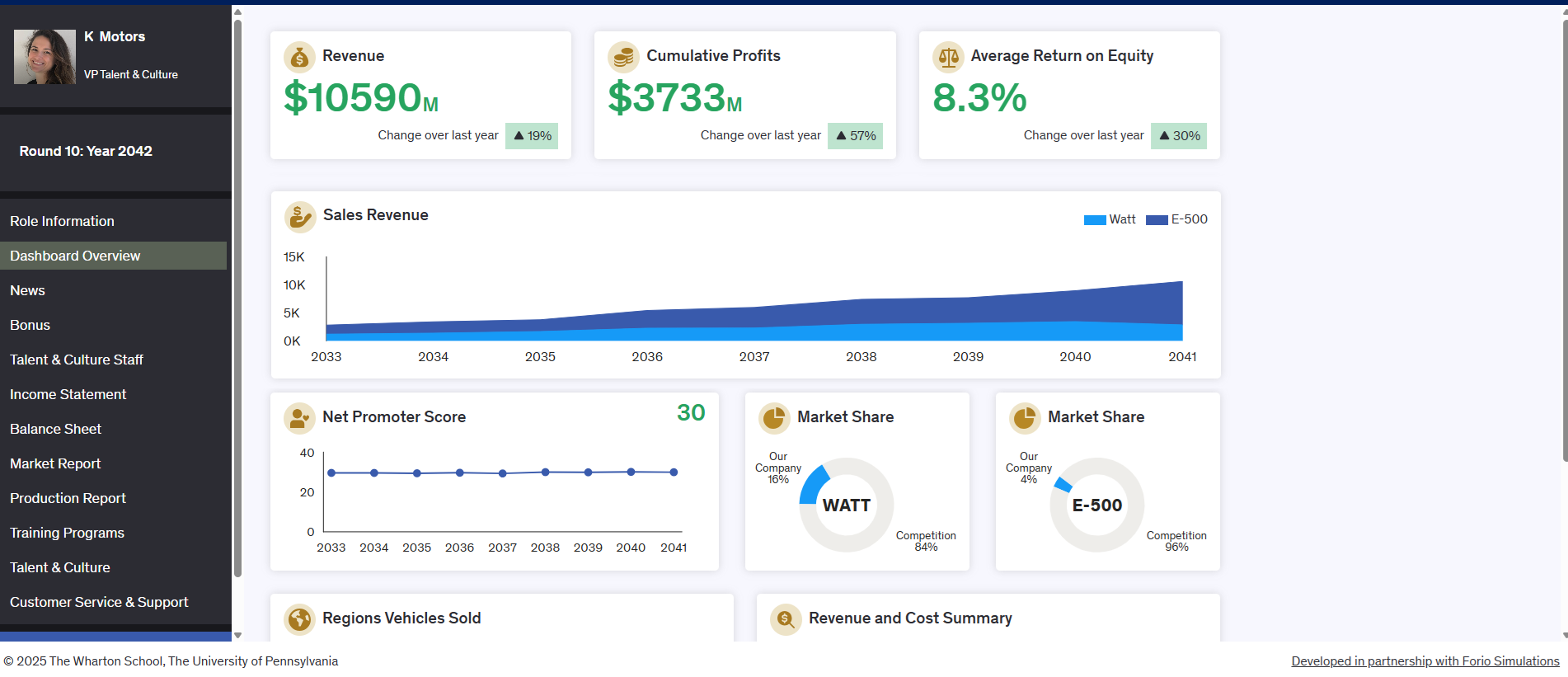
The Wharton Teamwork and Leadership Simulation (WTLS) is the simulation within the course where teams of six students run an electric car company, navigating business strategy alongside interpersonal challenges. This has been part of the Wharton MBA experience for more than two decades. But as expectations for contemporary leadership, and the tools those leaders use, have evolved, Wharton saw an opportunity to significantly rethink how the simulation could better reflect modern business realities.
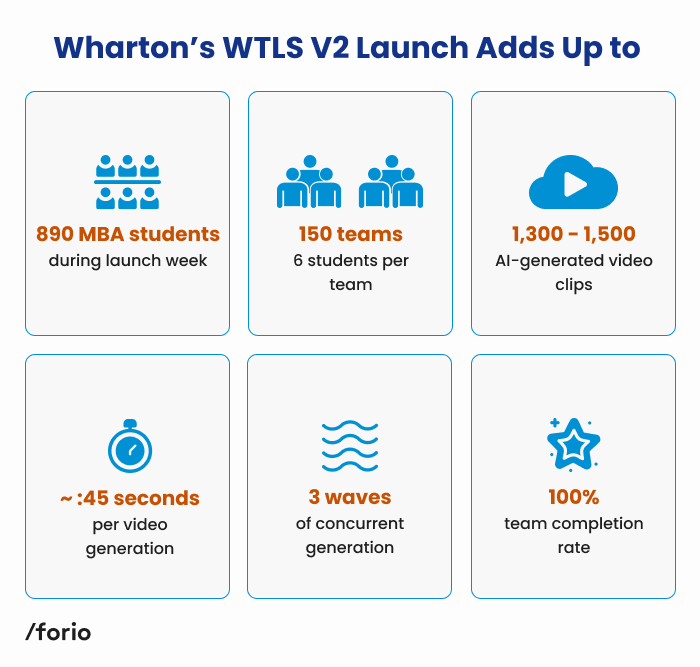
Following a multi-year reinvestment and redesign effort with Forio, Wharton launched a major new version of the experience to 890 incoming MBA students in fall 2025. The WTLS v2 launch marked both the continuation of a long-standing tradition and an innovative step forward in experiential learning at scale.
“This simulation is enshrined in maybe the most important course in the Wharton curriculum, and thousands of students will play this simulation in the coming years,” said Joe Lee, Wharton's Senior Director of Learning Innovation and Collaboration.
That importance shaped every design decision that followed.
The Partnership: A Simulation That Came Full Circle
Wharton has partnered with Forio since 2006, making WTLS one of the earliest collaborations between the two organizations. In that time, the simulation evolved alongside Wharton’s approach to leadership education, adapting to new research, technologies, and expectations of what experiential learning can deliver.
The 2025 launch of WTLS v2 marked a full-circle moment: a complete reimagining of a flagship simulation that would introduce students not only to Wharton’s leadership philosophy, but to the realities of modern, AI-enabled business decision making.
“This project was only successful because of the deep partnership between Forio and Wharton which spans over a decade,” stated Lee.
The simulation is taught and stewarded by Wharton’s senior faculty and academic leadership, reflecting its role as a foundational component of the MBA program rather than a standalone exercise.
Wharton Faculty Include:
- Deputy Dean Nancy Rothbard
- Adam Grant, best-selling author and organizational psychologist
- Samir Nurmohamad
- Michael Parke
The Challenge: Scaling Creativity in a High-Stakes Environment
WTLS runs as a one-week intensive, with students placed into teams of six to run an electric car company. Over the course of the simulation, teams make strategic business decisions, navigate leadership challenges, and respond to evolving scenarios.
The scale is formidable:
- 850 - 890 students participating simultaneously
- 150 teams working in parallel
- Students distributed across Wharton’s Huntsman Hall
The simulation delivered in three major waves to manage concurrency
Wharton wanted to introduce a creative marketing component, asking teams to produce a short video commercial for their company. While earlier versions of the simulation were highly effective for analytical decision-making, they were designed at a time when creative expression in business simulations was necessarily more constrained.
Historically, simulations have focused on text, numbers, and static visuals. Producing professional-quality video has typically required specialized animation skills, costly tools, or extended production timelines—factors that were difficult to accommodate within a fast-paced, live classroom environment.
The goal was balance, not novelty: pairing analytic rigor with creative leadership without sacrificing reliability, accessibility, or scale.
What Wasn’t Possible in the Original WTLS v1 Simulation
Before generative video, there was no realistic way for non-technical students to bring marketing ideas to life inside a live simulation.
Video-based creativity was effectively out of reach. Students could describe a vision, but not realize it, resulting in a gap between how business leaders are asked to think in the real world and what simulations could practically support.
That gap became the design problem WTLS v2 set out to solve.
The Implementation: Generative Video Embedded in the Simulation
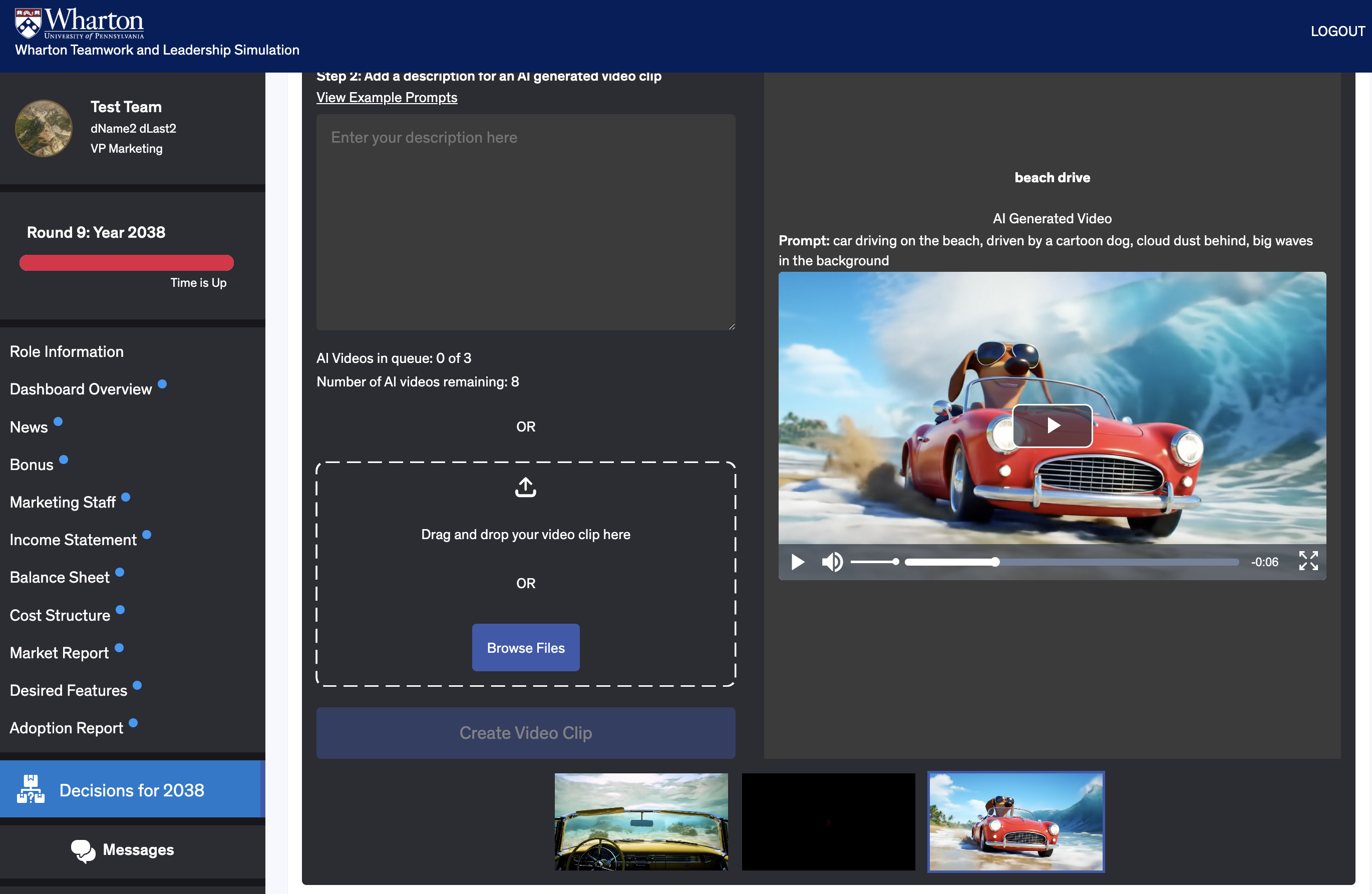
Forio integrated Gemini Veo directly into the simulation workflow via a web-based editor, allowing students to generate short video clips using natural language prompts without ever leaving the platform.
During the week-long program:
- More than 850 Wharton MBA students used Gemini Veo to create AI-generated car commercials
- Students generated 1,300 to 1,500 eight-second video clips
- Each clip rendered in approximately 45 seconds, enabling rapid iteration
- The system handled three waves of ~50 concurrent video generations, with special rate-limit approval
- All 150 teams successfully completed their video projects
Creativity became an integral part of the decision-making loop, not an afterthought.
“This wasn’t about adding AI for its own sake. The goal was to make creativity as immediate and actionable as any financial or operational decision inside the simulation. This integration with Gemini Veo enabled Wharton’s students to experience carrying an idea from concept to execution, the same way leaders do when strategy, creativity, and constraints collide in the real world,” said Drew Marx, CEO of Forio.
Launching WTLS v2: A Dramatic Improvement in Student Engagement
The impact was immediate, visible in both the energy of the room and how students couldn’t help but refine their ideas until the final minutes of the simulation. Often, they were running late to subsequent sessions as teams enthusiastically experimented with tone, messaging, and visual storytelling in the same way they debated pricing or production strategy.
Faculty reported that the Veo-powered activity generated exceptional enthusiasm and carried directly into next-day debriefs. Compared to previous creative exercises with similar learning goals, the experience was described as a dramatic improvement in both engagement and outcomes.
Just as importantly, the tech worked under pressure of a live environment and at scale.
Why This AI Innovation Matters for Business Education Simulations
WTLS v2 demonstrates a viable shift in how AI technology can be used in business education, not just as an analytical aid, but as a tool for creative leadership and collaboration.
Students weren’t learning about AI in the abstract. They were working with it by experimenting, refining, and integrating it into team-based decision-making under real constraints.
For Wharton, the project reinforces its position as a leader in business education.
For Forio, it demonstrates the team’s ability to design and deliver complex, AI-enabled simulations at scale on top of its Epicenter platform.
And for the tens of thousands of MBA students who will play this simulation in the years ahead, it sets the tone from day one: leadership today requires both analytical and creative fluency and the ability to work effectively with intelligent tools.
For what may be the most important course in the Wharton MBA curriculum, that lesson matters now more than ever.
Read The Latest Forio Insights

How the Coffee Trade Simulation Builds Real-World Supply Chain Skills
How ASU turned the coffee industry into the perfect model for teaching supply chain management across university and corporate settings.
Read Now
How a Wildfire Mitigation Simulation is Teaching Public Policy and Group Communication
CU Boulder’s Wildfire Mitigation Simulation uses real-world scenarios to teach students public policy, negotiation, and group communication through experiential learning.
Read Now

The Bullwhip Effect: Supply Chain Lessons from Industry and the Near Beer Simulation
Inspired by MIT’s Beer Game, Forio’s Near Beer simulation immerses learners in real supply chain challenges.
Read Now